Air Cooling vs. Liquid Cooling: Which CPU Cooler Is Right for You
Neither air nor liquid cooling is universally "better" — they trade off differently on performance headroom, noise, reliability, and long-term maintenance.
Neither air nor liquid cooling is universally "better" — they trade off differently on performance headroom, noise, reliability, and long-term maintenance.
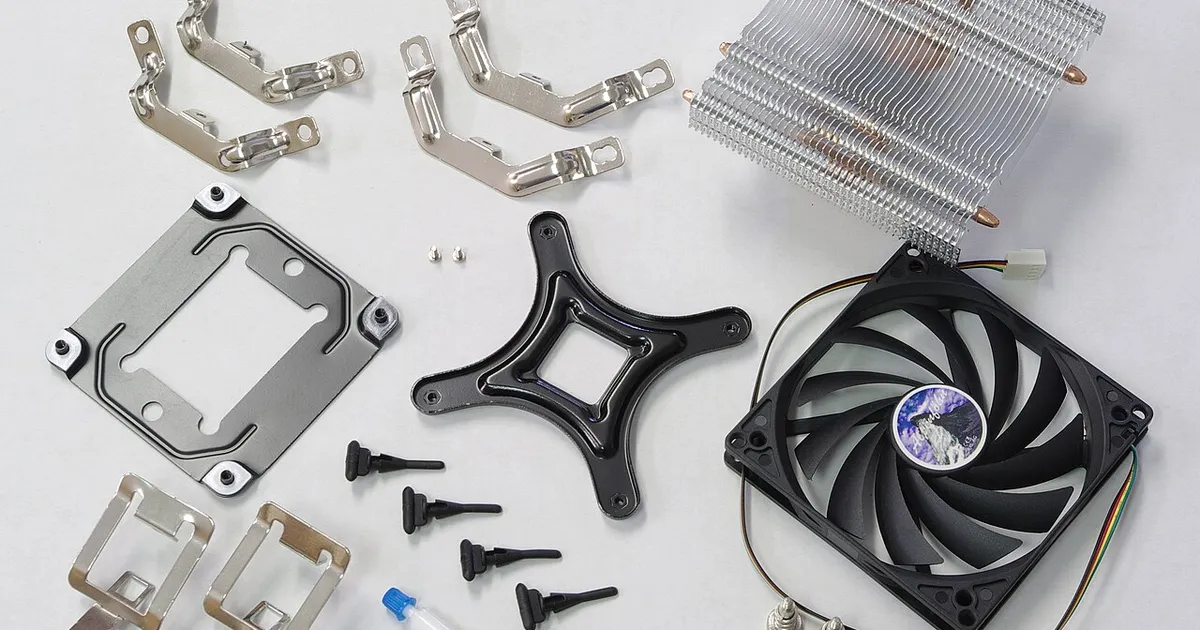
Photo by smial (talk) / Wikimedia Commons / FAL
Every CPU needs a cooler to keep it running at safe temperatures, and the two main options — air and liquid (specifically closed-loop, “all-in-one” liquid coolers, the kind most gamers actually consider) — solve the same problem in genuinely different ways, each with real advantages depending on your priorities.
How each one works
Air coolers use a metal heatsink, typically with heat pipes, to draw heat away from the CPU and dissipate it through metal fins, with one or more fans blowing air through those fins to carry the heat away. Closed-loop liquid coolers use a pump-driven loop of liquid coolant to carry heat from a block mounted on the CPU to a radiator, usually mounted with fans at the front or top of the case, where the heat is released into the case airflow. Both ultimately rely on case airflow to expel heat from the system — liquid cooling doesn’t remove heat from the case, it just relocates where that heat is released.
Performance and size tradeoffs
At the high end, large liquid cooling radiators can offer more cooling capacity than most air coolers can match, particularly useful for higher-power CPUs pushed harder, such as when overclocking. But high-end air coolers are genuinely competitive with mid-size liquid coolers for the vast majority of CPUs at stock or moderate settings — the gap mainly opens up at the top end of both categories, not in typical mainstream comparisons. Air coolers also tend to have a more predictable size and weight profile, while radiator size for liquid cooling directly affects case compatibility in ways that need to be checked carefully.
Noise and reliability
A quality air cooler is a fully passive heat transfer system apart from its fans, with no pump and no liquid — which means fewer points of potential failure and, generally, a longer expected service life with no maintenance required. Liquid coolers add a pump, which introduces its own (typically low, but nonzero) failure risk and a small amount of pump noise on top of fan noise, though pump noise on quality units is usually minor. The rare failure mode worth being aware of with any liquid cooler is a coolant leak — modern closed-loop units are designed to minimize this risk, but it remains a small structural difference from air cooling, which has no equivalent failure mode since there’s no liquid involved at all.
Cost and case clearance
Air coolers are generally more affordable at a given performance tier and have simpler installation, particularly for CPU sockets they’re rated to support with widely available mounting hardware. Liquid coolers, particularly larger radiator sizes, require a case explicitly rated to support that radiator size in a specific mounting location — this needs to be checked carefully, since not every case fits every radiator size, and mounting location options vary between cases too. A large air cooler also requires its own clearance check against case height limits and can occasionally conflict with tall RAM modules, which is worth verifying for particularly large coolers.
Making the choice for your build
If simplicity, long-term reliability, and value are your priorities, and your case has good clearance for a large air cooler, air cooling is a completely sound default for the overwhelming majority of builds, including most gaming systems without aggressive overclocking plans. If you’re building a system with a higher-power CPU pushed hard, want the aesthetic of a radiator and RGB-lit block, or specifically want maximum cooling headroom for sustained heavy loads, a quality liquid cooler is a reasonable and increasingly common choice — just confirm your case supports the radiator size you’re considering before buying.
Our picks: CPU coolers
Shop on Amazon
Affiliate links.As an Amazon Associate I earn from qualifying purchases. Links below go to Amazon; prices and availability change, so check Amazon for current pricing.Affiliate disclosure
Thermalright Peerless Assassin 120 SE
Dual-tower air cooler that beats coolers twice its price.
Check price on Amazon
Illustrative photos: Photo by smial (talk) / Wikimedia Commons / FAL; Photo by Blackcat / Wikimedia Commons / CC BY-SA 4.0