How to Estimate the Power Supply Wattage You Actually Need
Power budgeting for a PC build is about more than adding up rough numbers. A conceptual guide to how wattage, headroom, and real-world power draw actually relate.
Main page for gaming pcs: Gaming PCs →
Power budgeting for a PC build is about more than adding up rough numbers. A conceptual guide to how wattage, headroom, and real-world power draw actually relate.
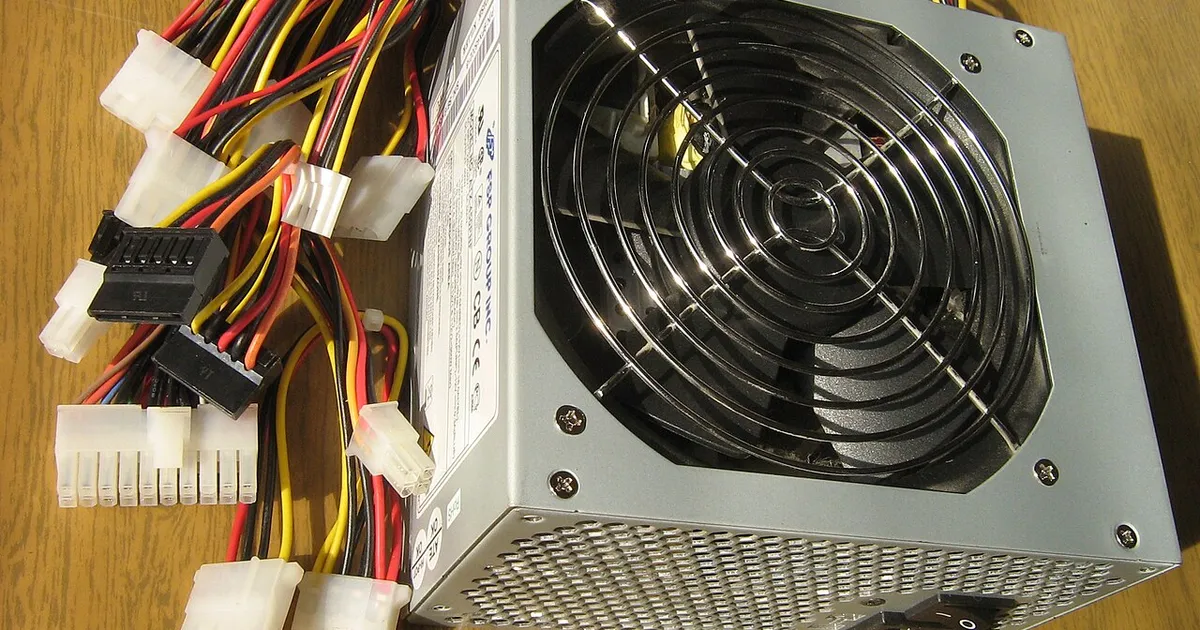
Photo by Victor Korniyenko / Wikimedia Commons / CC BY-SA 3.0
Picking a power supply wattage often gets treated as an afterthought at the end of a build list, but getting it wrong in either direction causes real problems — too little capacity risks instability under load, while wildly overshooting wastes money on capacity you’ll never use. Thinking about power budgeting conceptually, rather than chasing a single “safe” number, leads to a better decision either way.
Components don’t draw a fixed amount of power
The first thing to understand is that a component’s rated power figure is close to its maximum draw under heavy load, not what it constantly consumes. A graphics card idling on a desktop or in a light game draws far less than it does during a demanding scene, and a processor under light use draws less than it does under a sustained heavy workload. This is why simply adding up every component’s maximum rated figure tends to overestimate real-world draw — the whole system rarely hits every component’s peak at exactly the same moment.
Headroom exists for a reason, but more isn’t always better
Power supplies are generally most efficient somewhere in the middle of their rated capacity range, not at the very top or the very bottom. Undersizing a power supply means it may be forced to run near its maximum constantly, which is both less efficient and leaves no margin for momentary spikes in demand — brief bursts where draw exceeds the steady average. Oversizing by a huge margin doesn’t cause the same reliability concern, but it does mean paying for capacity that mostly sits unused, and running well below a unit’s efficient range for most everyday use. A reasonable buffer above your expected typical draw is the goal, not the largest number you can afford.
Efficiency ratings affect running cost, not raw capacity
Power supplies carry efficiency certifications that describe how much of the power drawn from the wall is actually delivered to your components versus lost as heat. A more efficient unit at the same wattage doesn’t give your components any more usable power — the wattage rating already accounts for output, not input — but it does mean less electricity wasted and typically less heat generated inside the case. Efficiency and capacity are separate decisions: one affects your ongoing costs and heat, the other affects whether you have enough power in the first place.
Momentary spikes matter more than steady-state averages
Modern high-performance components, particularly graphics cards, don’t draw power in a perfectly flat line — they can spike briefly well above their typical draw during sudden changes in workload. A power supply that’s sized right for average draw but with no cushion for these transient spikes can behave unpredictably under exactly the kind of moment you’d most want stability — a demanding, fast-changing scene. This is the practical reason experienced builders lean toward some buffer above the calculated average rather than the bare minimum.
A conceptual approach rather than a fixed formula
Rather than memorizing a specific wattage target, it’s more useful to reason through it: estimate the realistic combined draw of your most power-hungry components under sustained heavy use, add a reasonable margin for momentary spikes and future upgrades, and then check that figure against a unit’s efficiency sweet spot rather than just its maximum rating. This framing holds up regardless of how components change over time, which a memorized number doesn’t.
The bigger picture
Power supply sizing isn’t about hitting an exact number — it’s about balancing enough headroom for stability and future flexibility against the diminishing returns of buying far more capacity than you’ll use. Understanding the relationship between rated maximums, real-world draw, and momentary spikes is what makes that balance possible to judge for yourself.
Our picks: Power supplies
Shop on Amazon
Affiliate links.As an Amazon Associate I earn from qualifying purchases. Links below go to Amazon; prices and availability change, so check Amazon for current pricing.Affiliate disclosure
Illustrative photos: Photo by Victor Korniyenko / Wikimedia Commons / CC BY-SA 3.0; Photo by Baran Ivo / Wikimedia Commons / Public domain