PSU Efficiency Ratings and Connectors Explained
Wattage is only part of the power supply decision. Here is what efficiency certifications actually measure and why connector compatibility deserves just as much attention.
Main page for gaming pcs: Gaming PCs →
Wattage is only part of the power supply decision. Here is what efficiency certifications actually measure and why connector compatibility deserves just as much attention.
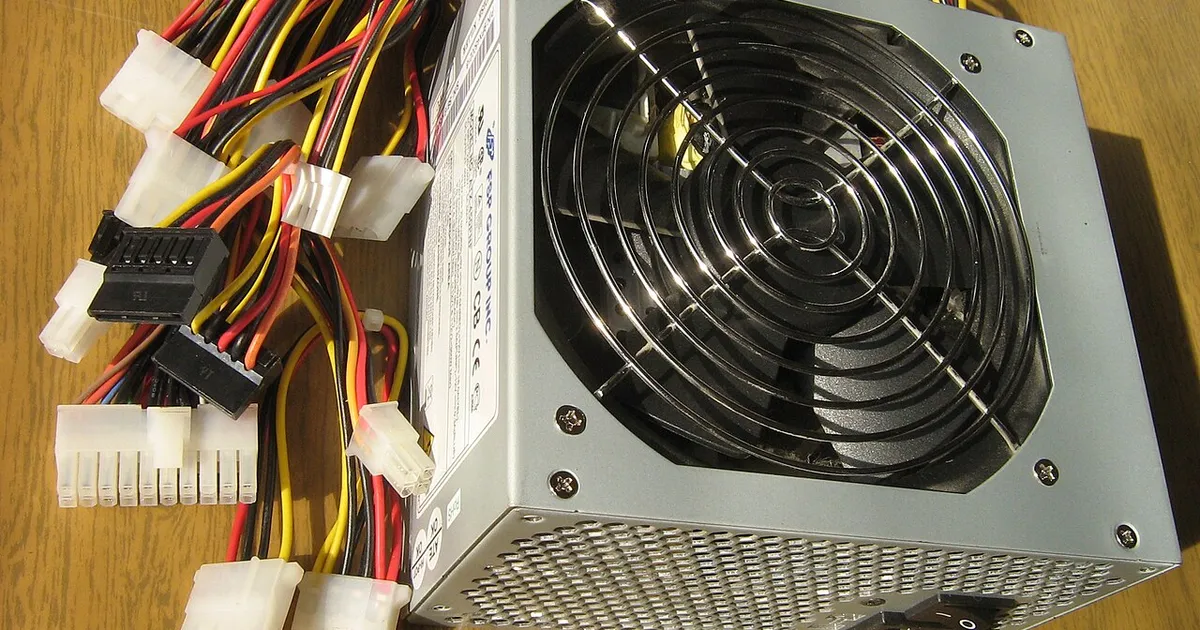
Photo by Victor Korniyenko / Wikimedia Commons / CC BY-SA 3.0
Wattage gets most of the attention when people talk about power supplies, but two other factors — efficiency ratings and connector compatibility — matter just as much for a build to run well and stay compatible with your components. Neither is complicated once you understand what they’re actually describing.
What efficiency ratings actually measure
An efficiency certification describes how much of the electricity drawn from the wall outlet is converted into usable power for your components, versus how much is lost as heat during that conversion. A power supply rated at a higher efficiency tier wastes less electricity for the same amount of power delivered to your system. This matters for two practical reasons: lower electricity waste over the life of the unit, and less heat generated inside the case, which can make cooling everything else slightly easier.
It’s worth being clear about what efficiency doesn’t do — it doesn’t add capacity. A highly efficient power supply rated at a given wattage still only delivers that same wattage to your components; it’s just wasting less power getting there. Efficiency and capacity answer different questions, and conflating them can lead to the mistaken idea that a “better” efficiency rating means you can undersize the wattage.
Efficiency also tends to vary by load level
Most power supplies aren’t equally efficient across their entire range — they tend to hit their best efficiency somewhere in the middle of their rated capacity, and be somewhat less efficient at very light loads or right up against their maximum. This is part of why sizing a power supply well — enough headroom to sit comfortably in that efficient middle range, without buying vastly more capacity than you’ll use — has benefits beyond just safety margin.
Connectors are a compatibility question, not just a capacity one
A power supply can have more than enough total wattage and still be a poor match for your build if it doesn’t have the right connectors for your components. Modern graphics cards, in particular, often require specific connector types and sometimes multiple connectors feeding a single card. Motherboards and processors have their own separate connector requirements. It’s entirely possible for a power supply to be rated for enough total wattage while lacking a connector a specific graphics card needs, which makes connector compatibility a check worth doing on its own, separate from the wattage math.
Modular design affects installation, not performance
Some power supplies let you attach only the cables you actually need, rather than having every possible cable permanently wired in. This affects how tidy your case interior ends up and how much unused cable you have to tuck away, but it doesn’t change how much power the unit delivers or how efficiently it does so. It’s a convenience and airflow consideration, not a performance one — worth knowing so you don’t overweight it relative to wattage and connector fit when comparing options.
Reading a power supply as a full package
Rather than judging a power supply purely by its wattage number, it helps to check all three factors together: whether the wattage covers your realistic draw with reasonable headroom, whether the efficiency tier fits how much you care about running cost and heat, and whether the connector set actually matches what your specific components require. A unit that’s strong in wattage and efficiency but missing the right connector for your graphics card isn’t actually a match for your build, regardless of how good its other numbers look.
The takeaway
Efficiency and connectors are separate axes from raw wattage, and both deserve their own check rather than being assumed from a single headline number. A power supply decision that only looks at wattage is only half-informed.
Our picks: Power supplies
Shop on Amazon
Affiliate links.As an Amazon Associate I earn from qualifying purchases. Links below go to Amazon; prices and availability change, so check Amazon for current pricing.Affiliate disclosure
Illustrative photos: Photo by Victor Korniyenko / Wikimedia Commons / CC BY-SA 3.0; Photo by Baran Ivo / Wikimedia Commons / Public domain